 Remy Guercio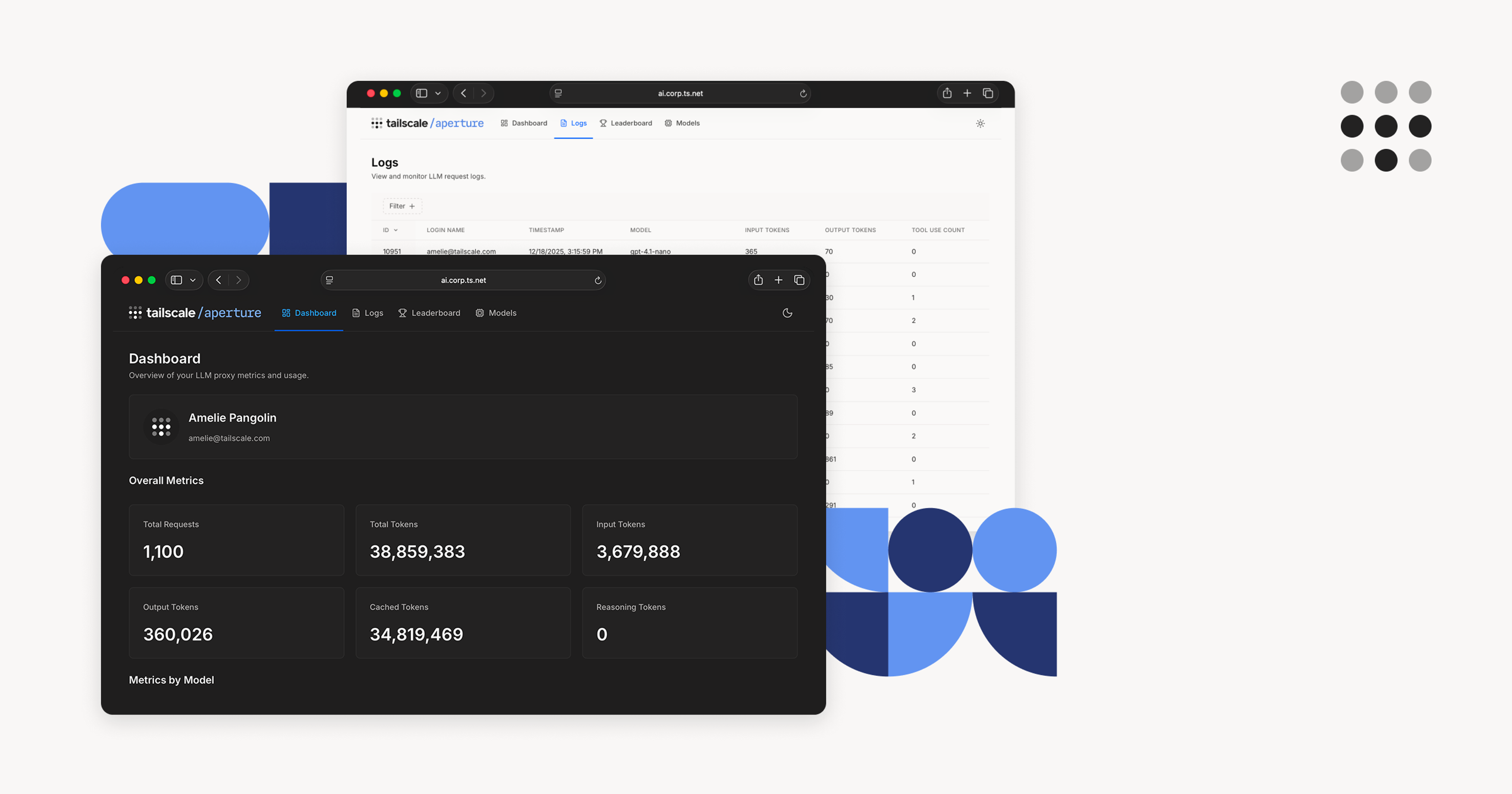
It’s understandable if you missed it, but coding agents are getting good [^1]. Throughout 2025 they went from interesting in limited circumstances, to nearly there, to being able to generate and review code at a surprisingly advanced level. As coding agents have been able to take on more and more complex tasks, it’s no surprise more and more folks want to bring them to work, even if their company’s tooling and policies are far from ready.
With growing interest in coding agents—not only from individual engineers, but also executives looking for force multipliers—security, IT, and engineering management are left with a difficult question: How can they enable secure, visible AI usage, without putting up roadblocks that engineers will work around?
We heard from countless customers that they don’t have a good answer to this. The thing is, neither did we. So we built one.
Bringing AI usage into focus with Aperture by Tailscale
Aperture, currently in alpha release, is an AI gateway that provides visibility into coding agent usage across your entire organization without getting in the way of developers. It works great with most CLI or VS-Code-based AI coding tools, including Claude Code, Codex, Gemini CLI, and custom agent frameworks. It uses the underlying identity built into every Tailscale connection to eliminate distributing API keys to developer laptops, VMs, containers, CI/CD platforms (e.g. GitHub Actions), and other sandbox environments.

Any environment that can connect via Tailscale can use Aperture to eliminate keys and improve visibility. From an end-user perspective, setting up Aperture with an agent like Claude Code is as simple as adding the following to ~/.claude/settings.json, either manually or via MDM:
{
  "apiKeyHelper": "echo '-'",
  "env": {
    "ANTHROPIC_BASE_URL": "http://ai"
  }
}
Save time with just one key to rule them all
Giving developers or agents within your organization access to new models or providers is as simple as adding a single API key and endpoint to Aperture's settings. Once a new provider is added, Aperture associates user and machine identities with API usage, while transparently passing along traffic to the LLM provider.

Since Aperture picks up identity information from your Tailscale network (tailnet), there is no need to set up user accounts or keys. Out of the gate, Aperture supports all major LLM providers using their native protocols, as well as most major cloud AI endpoints, self-hosted LLMs, and LLM inference providers that conform to the OpenAI v1 response or chat completions endpoint specifications.
Make usage visible
The visibility provided by Aperture can be used in two main ways. The first is to understand AI adoption across an organization. The second is to look for signs of compromised or unapproved usage of agents or tools.
Understand AI adoption and cost
Models, agents, and AI usage best practices are constantly changing, and sometimes seemingly innocuous changes can have drastic impacts on tokens and, by extension, cost. By collecting usage information into a single place, engineering and IT leaders can get a complete picture into both user and agent token efficiency across the organization and providers.

Secure everything with simple access
When users feel security postures are too cumbersome, they’ll work around them and end up out on their own, unmonitored and unprotected. When deployed, Aperture quickly becomes the lowest-friction way to access AI at your company, while seamlessly attaching existing machine and user identities to logs, sessions, local tool calls, and local or remote MCP tool calls. All information can be easily viewed, filtered, and sorted inside Aperture, while also exported to S3 for easy SIEM integration.

A platform on a platform
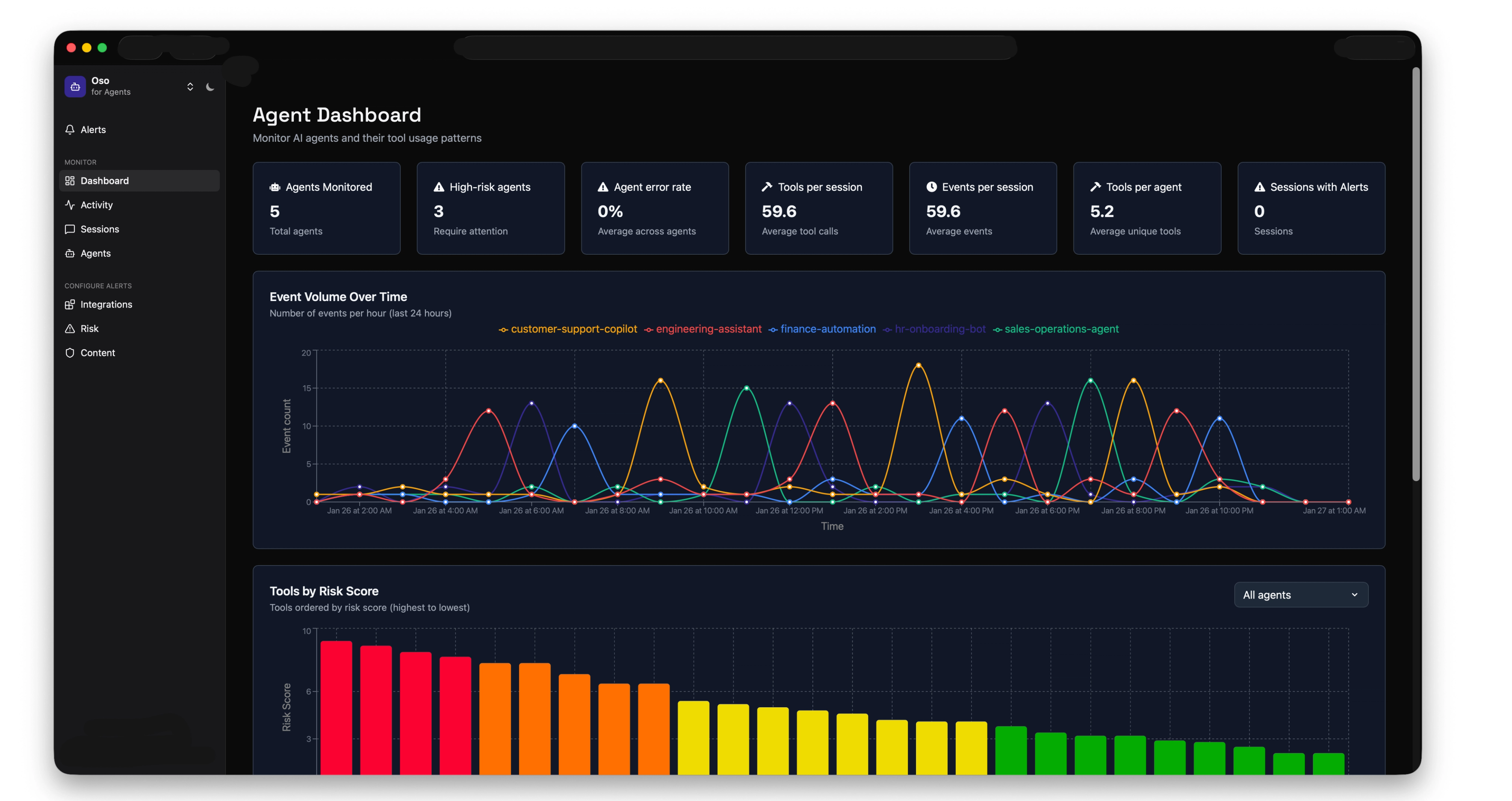
While Aperture itself is built on the Tailscale platform to leverage the built-in identity and connectivity, we’re making Aperture extensible as well. As part of making the safe way of providing AI access the easy way, we’ve made Aperture extensible, so that any company can provide detailed AI agent security features on top of Aperture. One of the first companies we'll be partnering with is Oso, to provide additional visibility, controls, alerting, and auditing for AI agents.
Visibility into coding agents is just the beginning
In our initial alpha release of Aperture, we’ve focused mostly on providing security and insights for coding agent usage. But coding agents, we believe, are just the beginning of the proverbial agentic AI iceberg.
So in addition to expanding Aperture to cover more typical chat-UI-based use cases, we’re also planning support for other agentic workloads. Inside organizations there are tons of other processes beyond coding, waiting for their coding agent moment. And, Aperture will be there to provide the right visibility, control, convenience, and ease of use to make it happen.
How to get started with Aperture
Try it out today for free by signing up here. Like the Tailscale Personal plan, Aperture comes with similar usage limits of 3 free users. However, it can be used on any plan type. If you are trying to safely deploy coding agents for 10s, 100s, or 1000s of engineers inside your organization or building internal agents, sign up for the waitlist. We’d be happy to walk through your requirements and set you up with a dedicated instance of Aperture.
Please keep in mind that this is an early alpha release of an experimental product. It’s still a work in progress, so pieces may be incomplete, features may change, and you may experience bugs. We’re sharing it to learn and gather feedback, so before using it in production, please talk to us.


